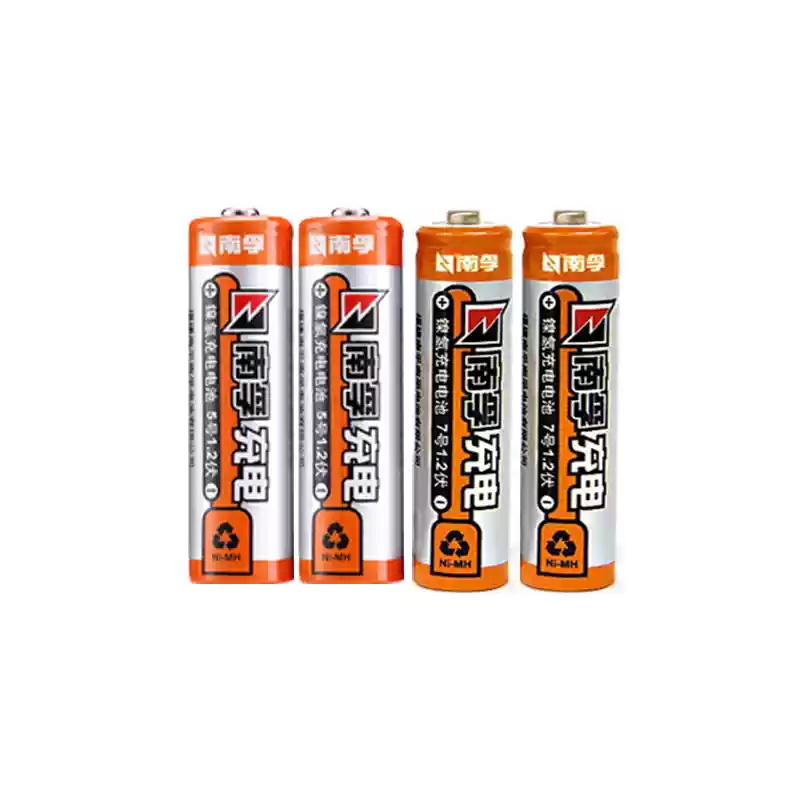

Rechargeable Batteries AAA, Charging capacity up to 960 mAh
|
Technical Parameter |
Details |
|
|
Battery Type |
AAA rechargeable battery |
|
|
Capacity |
Up to 960 mAh, providing a relatively high energy storage capacity for extended use in various devices such as remote controls, toys, and flashlights |
|
|
Charging Voltage |
Typically, designed to be charged using standard chargers compatible with this voltage requirement. The charging voltage is optimized to ensure efficient and safe charging of the battery without over - charging or under - charging, which could affect battery lifespan and performance. |
|
|
Charging Time |
Approximately [Y] hours when using a charger with a specified charging current. The charging time may vary depending on the charger's output current and the initial state of charge of the battery. For example, a higher - current charger may reduce the charging time, but it must be compatible with the battery's charging specifications to avoid overheating or damaging the battery. |
|
|
Discharge Rate |
Can sustain a certain discharge rate depending on the device's power consumption. For high - drain devices, the battery should be able to provide a sufficient current output without significant voltage drop. For instance, it may be able to deliver a continuous discharge current of [Z]mA for a certain period while maintaining a stable voltage within the acceptable operating range of the device. |
|
|
Cycle Life |
The number of charge - discharge cycles the battery can endure before its capacity significantly degrades. This AA rechargeable battery typically has a cycle life of [N] cycles. After [N] charge - discharge cycles, the battery's capacity may drop to a certain percentage (e.g., 80%) of its original capacity, indicating that it may need to be replaced. |
|
|
Operating Temperature Range |
Extreme temperatures outside this range may affect the battery's performance, charging efficiency, and lifespan. For example, at low temperatures, the battery's capacity may decrease, and at high temperatures, it may experience increased self - discharge and potential damage to the internal components. |
|
|
Self - discharge Rate |
Expressed as a percentage of capacity loss per unit time when the battery is not in use. This AA rechargeable battery has a relatively low self - discharge rate, losing no more than [M]% of its capacity per month at room temperature. A low self - discharge rate ensures that the battery can retain its charge for a longer period when stored, making it convenient for standby applications. |
|
|
Terminal Voltage |
The voltage at the battery's terminals when fully charged is [Fully Charged Voltage]V, and when discharged to its cut - off voltage, it is [Cut - off Voltage]V. The cut - off voltage is set to prevent over - discharge, which can permanently damage the battery. Different devices may have different requirements for the battery's terminal voltage, and it is important to ensure that the battery's voltage remains within the acceptable range for proper device operation. |
|
|
Safety Features |
Equipped with safety mechanisms to prevent over - charging, over - discharging, and short - circuits. These may include built - in thermal protection to prevent overheating during charging or discharging, and a separator material to prevent internal short - circuits. The battery is designed to meet relevant safety standards, such as UL (Underwriters Laboratories) or IEC (International Electrotechnical Commission) standards, ensuring safe use in a wide range of applications. |
|
|
Material Composition |
Electrode materials: The anode is typically made of [Anode Material], and the cathode is made of [Cathode Material]. These materials are selected for their high energy density, good charge - discharge performance, and long - term stability. For example, the anode material may be a type of metal alloy that can store and release lithium ions efficiently during the charge - discharge process.Electrolyte: The electrolyte used in the battery is [Electrolyte Type]. It plays a crucial role in facilitating the movement of ions between the anode and cathode during charging and discharging. The electrolyte is formulated to be stable, non - flammable, and to have good ionic conductivity to ensure efficient battery operation. |
|
|
|
|
|